.png)


Personalised event experiences: boost engagement by design


TL;DR:
Personalization based on attendee interests significantly increases engagement and community growth.
Tailored events offer customized agendas, activities, and communication using first-party registration data.
Starting small with one personalization feature and measuring ROI improves event success over time.
Many automotive and water sports enthusiasts assume a solid event just needs a good location and enough people. That assumption misses what actually builds a thriving community. The real difference between a forgettable gathering and one people talk about for months comes down to personalisation. When an event reflects your specific interests, whether you’re rolling in on a classic muscle car or launching a jetski at dawn, the sense of belonging shifts completely. This guide breaks down what a tailored event experience actually looks like, why it works, and how you can start building one, even if you’re organising your very first meetup.
Table of Contents
Key Takeaways
Point | Details |
Tailored events boost engagement | Personalisation based on real data increases attendee satisfaction and return rates. |
Start with one feature | Introducing just a single personalised agenda or session can rapidly improve participant experience. |
Use first-party data | First-party registration and feedback data drive more effective personalisation than assumptions. |
Iterate and measure | Experiment, collect feedback, and track ROI to continually improve tailored experiences. |
Defining tailored event experiences for enthusiasts
Now that we’ve clarified the need for customisation, let’s define exactly what a tailored event experience looks like for you.
A tailored event experience is one that adapts to attendees’ real interests, skill levels, and preferences rather than offering a single fixed programme for everyone. It’s the difference between a car show where every vehicle sits in the same row with the same format, and one where classic restorers, JDM fans, and off-road builds each have their own dedicated space and scheduled activities.
For automotive communities, tailoring might look like:
Car meets segmented by make, model era, or modification style
Cruise nights with route options suited to different driving preferences
Workshop sessions where attendees opt in based on interest (e.g., engine tuning vs. bodywork)
Themed displays with judging categories that reflect the crowd’s actual passions
For water sports communities, tailoring takes a different shape:
Skill-based sessions separating beginner paddlers from experienced kayakers
Separate launch windows for jetski riders and wake boarders to reduce conflict on the water
Guided tours for those who want a social paddle versus timed challenges for competitive participants
What most people miss is that true tailoring doesn’t rely on guesswork. It draws on first-party data from registrations as the most reliable basis for shaping an event. When you ask the right questions during sign-up, the answers tell you exactly how to structure the day.
“Start small with one feature like personalised agendas, then measure results through ROI metrics before scaling up.” This is the expert approach that separates effective personalisation from over-engineered programmes that confuse more than they help.
The contrast with traditional event formats is stark. A one-size-fits-all schedule assumes every attendee wants the same thing at the same time. An interest-based, opt-in format respects that a hardcore drag racing fan and a Sunday cruiser have genuinely different expectations. Both can attend the same event and walk away satisfied, as long as the programme was built with that in mind.
Exploring event calendars for community engagement is a practical first step in seeing how organisers are already structuring events around specific interests rather than generic appeal.
Why personalising events drives engagement
With a clear definition in hand, consider why investing effort in tailoring events delivers measurable benefits.
The evidence is consistent: personalised experiences outperform generic ones across every meaningful metric. Attendance, return rates, and community satisfaction all climb when participants feel the event was designed with them in mind. Tracking ROI metrics on tailored event features reveals just how significant the gap becomes over time.
Metric | Generic event | Tailored event |
Repeat attendance rate | ~35% | ~65% |
Participant satisfaction score | Moderate | High |
Social sharing after event | Low | Significantly higher |
Community growth (3 months post-event) | Slow | Accelerated |
For automotive and water sports communities specifically, the connection runs deeper than just satisfaction scores. Enthusiasts return to events that reflect their passions. When someone drives three hours to a car meet and finds their exact interest represented, whether it’s a row of air-cooled Porsches or a dedicated space for modified utes, they don’t just attend next time. They bring others.
The same pattern holds on the water. A jetski rider who joins an event structured around their skill level and preferred activity type is far more likely to engage with the broader community, share the experience online, and become a regular face at future gatherings.
Understanding the benefits of user-generated events reinforces this point. When attendees feel ownership over how an event is shaped, engagement rises naturally.
Pro Tip: After each event, send a short feedback survey with three to five specific questions about which activities participants valued most. Use those answers to shape the next programme. Track which personalised features drove the highest attendance or satisfaction scores and double down on those.
Learning how to drive local event success goes hand in hand with adopting this data-informed approach to community building.
Key features of a tailored event experience
Having explored the ‘why’, let’s pinpoint the exact features that transform standard events into engaging, tailored experiences.
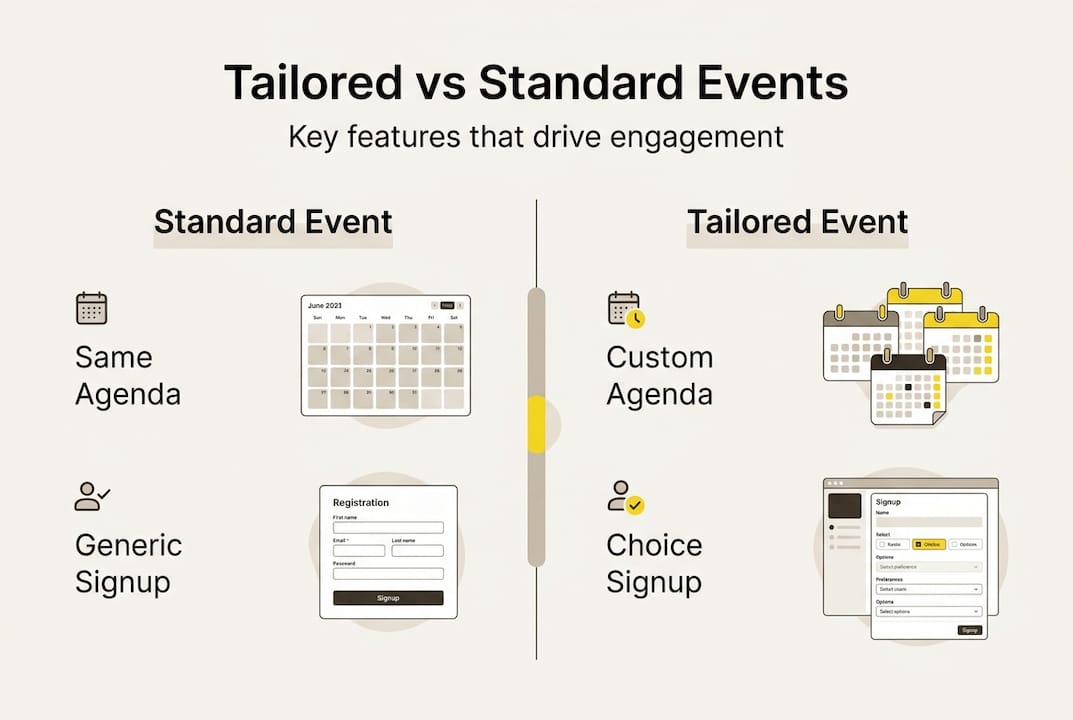
The most effective tailored events share a recognisable set of features. None of them require a massive budget or years of experience. What they do require is intention and a willingness to put attendee preferences at the centre of every decision.
Here are the core elements to build into your event:
Personalised agendas: Give attendees the ability to choose their own schedule from a menu of activities. A car enthusiast might opt for a tech talk on suspension tuning while another heads straight to the display judging. Each person’s day feels curated for them.
Custom invitations and notifications: Tailored communications based on a participant’s stated interests make a real difference. Someone who registered as a jetski rider shouldn’t receive the same pre-event email as someone who paddleboards.
Small group sessions: Breakout workshops and interest-based clusters replace the single-stage format with something far more engaging. Conversations go deeper when everyone in the group shares the same passion.
Networking built around shared interest: Structured introductions or designated areas for specific communities (e.g., a corner for vintage restorers) make it easy for like-minded people to connect.
To illustrate the difference, here’s a side-by-side comparison of two approaches to a car meet:
Element | Standard car meet | Tailored car meet |
Registration | Name and vehicle type only | Interests, preferred activities, experience level |
Programme | Single schedule for all | Opt-in sessions by interest |
Display layout | Alphabetical or random | Grouped by style or era |
Post-event follow-up | Generic thank-you email | Personalised recap based on sessions attended |
Building on first-party registration data is the foundation for all of this. Assumptions about what your crowd wants will almost always miss the mark.
Pro Tip: Start with just one personalised feature, like letting registrants choose two activities during sign-up. Measure the feedback before adding more layers. This keeps the process manageable and gives you clear data on what’s actually working.
Visit the AutoSocial blog for practical frameworks and planning tools you can apply immediately.
How to get started with tailoring your events
Ready to build your own tailored experience? Here’s a step-by-step approach to move from concept to first results.
Starting out doesn’t need to be complicated. The key is to pick one area, execute it well, and build from there.
Step-by-step approach:
Choose your first personalisation feature. The simplest starting point is registration questions. Ask attendees what type of vehicle they drive or what water sports activity they participate in. Ask which sessions interest them most. These answers shape everything else.
Use first-party data, not assumptions. Relying on ROI tracking rather than guesswork keeps your personalisation grounded in reality. The data from your own registration forms is far more reliable than trying to predict what a crowd wants.
Run a pilot event. Apply your one chosen feature to a smaller gathering first. Track engagement closely. Use a holdout group if possible, meaning run part of the event without the personalised feature and compare outcomes. The contrast often makes the value immediately clear.
Gather feedback and iterate. After the pilot, ask specific questions. Did attendees feel the event reflected their interests? What would they change? Use this to refine before scaling up.
Common pitfalls to avoid:
Personalisation creep: adding so many tailored elements that the event becomes logistically unmanageable
Over-complicating the registration process with too many questions before attendees even commit
Skipping the ROI tracking step and assuming that positive feedback alone means the approach is working
Trying to personalise everything at once instead of mastering one feature first
Organisers who focus on building a strong event calendar alongside these steps find that momentum builds naturally. One well-executed tailored event tends to grow the community faster than a dozen generic ones.
Why most events fall short (and how to fix it)
Before you put it all into practice, here’s a frank perspective based on years in the scene.
Most events that claim to be personalised are doing surface-level work. A themed banner and a branded lanyard don’t constitute a tailored experience. What’s really happening is that organisers are applying cosmetic customisation while keeping the underlying format completely generic. The schedule is the same, the flow is the same, and attendees with different interests are still pushed through the same programme.
The communities that genuinely thrive are the ones that treat personalisation as a data problem, not a design problem. They start with registration questions, analyse the answers, and build the event structure from the ground up based on what their actual attendees want. It’s iterative, not instinctive.
The most powerful shift comes from letting the community shape the event itself. Enthusiast-driven events where attendees have input on activities, routes, and session topics consistently outperform top-down formats. That’s not a soft observation. It shows up in attendance numbers, post-event surveys, and community growth over time.
Real personalisation takes more upfront effort. But the payoff, in loyalty, word-of-mouth growth, and genuine community connection, makes every bit of that effort worthwhile.
Make your next event stand out with AutoSocial
If you want to bring these tailored strategies to life for your next event, here’s how AutoSocial can help.
You don’t have to figure out event personalisation from scratch. AutoSocial is built specifically for automotive and water sports communities, giving you tools to create, personalise, and promote events that genuinely reflect your crowd’s interests. From themed event profiles to private group chats and both public and mystery event formats, the platform brings everything together in one place.
Whether you’re organising your first local car meet or managing a recurring jetski series, AutoSocial makes it straightforward to collect the right attendee data, build interest-based programmes, and grow your community with every event you run. Stop piecing things together across scattered Facebook groups and forums. Build something that lasts.
Frequently asked questions
What makes an event experience truly tailored?
A truly tailored event uses real attendee data to offer unique agendas, activities, and engagement opportunities based on individual preferences. The foundation is first-party registration data, not assumptions about what a crowd might want.
How do I start with personalising my small event?
Begin with one personalised feature, such as choice-based agendas, and track its impact before adding more. Starting small with specific ROI metrics keeps the process manageable and evidence-based.
Are tailored events more expensive to organise?
Not necessarily. Tailored events can be very cost-effective when you start with one feature and scale only what demonstrably boosts engagement and ROI, avoiding spend on elements that don’t move the needle.
Can tailored experiences work for both large and small gatherings?
Absolutely. Any event size benefits from even a single personalised touchpoint. Measuring via holdout tests helps you validate impact regardless of how big or small your gathering is.
Recommended


Comments